In short, the curtain that whispers in your ear
- Le rideau phonique, c’est le rempart textile discret pour retrouver un calme réel chez soi ou au boulot, franchement, un simple voilage ne rivalise pas, il faut de la densité, de la technique, de la matière qui pèse dans la main.
- Every decibel reduced means a peaceful night’s sleep—and you’ll feel the difference as soon as it’s installed: thickness that blocks out noise, tested and measured—nothing is left to chance.
- Don’t just pick something at random—it’s better to check the certification and go for a custom solution. Otherwise, watch out for decorative curtains that do nothing to block out noise.
Le bruit, cette onde têtue, s’infiltre dans vos vies par les moindres interstices, sans prévenir, sans gêne. Peut-être attendez-vous parfois le silence comme on attend la pluie après trois semaines de canicule. Vos oreilles, elles aussi, saisissent les infractions du dehors, ces moteurs, ces klaxons, tout ce qui perce la membrane trop poreuse de votre sérénité intérieure. Vous souhaitez trouver un refuge, pas forcément une forteresse, mais un repli discret en dehors de l’agitation qui suinte par les murs, à la fois dans la maison et au bureau. Cependant, rare se trouve celui qui obtient ce répit sonore sans rien changer à son espace. Vous pourriez opter pour un rideau phonique sur mesure afin de gagner en sérénité.
Vous essayez parfois de déplacer un meuble contre le mur, de doubler un rideau trop fin, rien ne semble suffire, car il insonoriser une pièce. Un rideau phonique sur mesure peut se présenter comme la meilleure parade, une stratégie architecturale quasi invisible, entre finesse textile et densité technique parfois insoupçonnée.
How a curtain works to reduce noise
The curtain, that time-honored decorative staple, has become a key acoustic tool—one that can sometimes surprise with its genuine effectiveness. When you consult a supplier, examine the fabric, and feel its texture, you’ll find that the material matters more than it first appears, and it’s an experience best appreciated through touch. You’ll quickly notice the fabric’s exceptional thickness and the technical choice of dense poly-cotton or multi-layered polyester.
The specific composition of acoustic textiles
The composition of acoustic curtains is no longer a mere afterthought, as you’ll see when you handle the sample. The thick wool seems capable of withstanding any aggressive sound waves, but the multi-layered polyester sometimes surprises you with its youthful versatility and moderate cost. The layering of the fabric creates mass, and this mass ultimately acts as a barrier against the chaos outside. On the other hand, you certainly shouldn’t overlook the option of densified cotton—a fabric that evokes the past but offers a modern technical solution.
Attenuation measured in decibels (dB)
Noise reduction is something you can measure and experience—it’s never just an abstract concept. When we talk about decibels, you check the packaging, and sometimes you have your doubts; a simple promise isn’t enough. The difference between a standard curtain that absorbs 7 dB and a professional soundproofing solution that blocks up to 31 dB is noticeable in use, and the difference is clear from the very first night. You recall a scientist explaining that every decibel reduction counts twice as much at night. Thus, the measurement, derived from independent laboratories, serves as your guide—not just another marketing claim.
La différence entre rideau phonique et rideau classique
Certains considèrent le rideau classique comme évidence décorative, or sa capacité d’absorption reste marginale. Vous faites le test un soir d’orage, le grondement filtre encore, rien ne change. Dès que le phonique s’installe, la pièce se métamorphose. Vous notez le calme retrouvé dans une chambre à côté d’un carrefour, ou la confidentialité rétablie lors d’un appel professionnel. Vous saisissez l’écart concret entre le gadget et la solution technique.
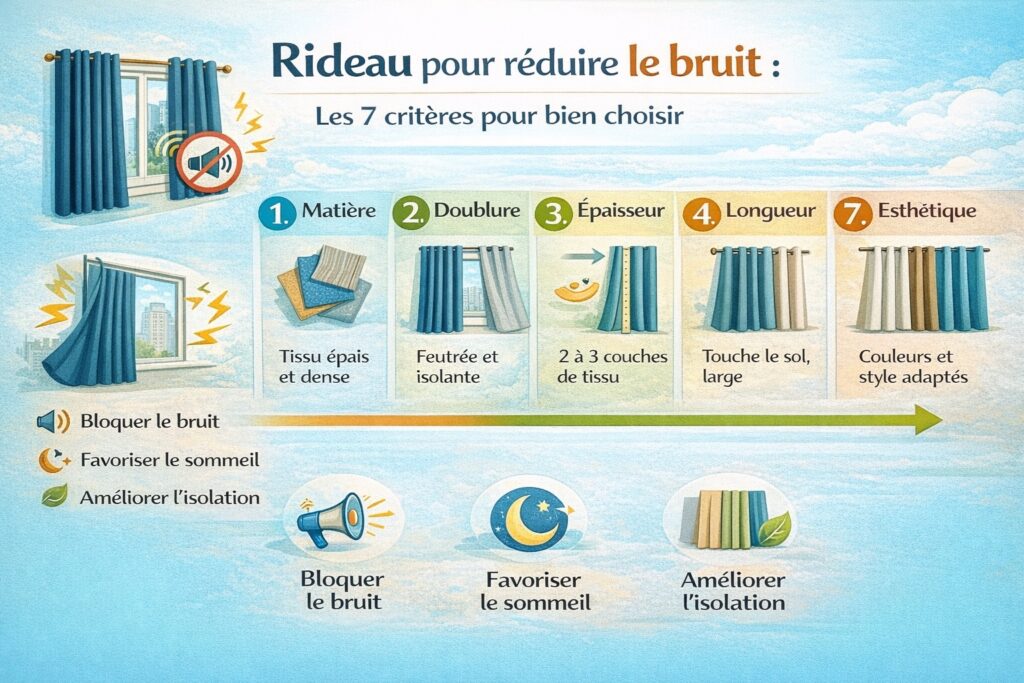
The 7 criteria for choosing a truly effective soundproof curtain
What are you looking for now, if not just a simple accessory but a technical ally that can be customized based on the room, your comfort needs, and the nature of the noise? Here is the backroom of choice, a quiet, lab-like space.
Proven acoustic performance
Certification and lab testing are just what the meticulous mind needs to feel reassured. The EN ISO 717 label rings a bell from your reading. You scrutinize the technical specifications, sort through the numbers, look for the advertised decibels, the thermal resistance, and the material derived from the manufacturing process. You’re wary of empty marketing claims and prefer quantifiable evidence. It makes perfect sense to choose a validated standard rather than mere sales talk.
Compatibility with the opening and the room
A curtain must be suited to its surroundings—the window, the door, and the ceiling height all matter. However, a large picture window calls for a thick, multi-layered fabric. For a small door, choose a simpler, more manageable fabric. Installation also depends on the track’s structure, a critical technical detail that determines whether the curtain can be installed at all or will end up wrinkled.
| Type of space | Window | Recommended curtain |
|---|---|---|
| Meeting room | Large bay | Thick, multi-layered curtain |
| Room | Single-pane glass | Rideau phonique double |
| Home | Standard door | Reinforced basic insulation |
Design and integration into the decor
Curtains have become a key element in interior design, making their mark through color choices, color palettes, and fabric weaves. Thus, charcoal grays and understated taupes dominate modern offices, while velvet adds brighter accents to contemporary spaces. You may be torn between the boldness of a color and the safety of a neutral. However, custom-made curtains simplify design, turning technical constraints into visual assets. It is entirely possible to strike a subtle balance between functionality and elegance.
Value for money and durability
La question du tarif vous effleure, forcément, personne ne souhaite jeter l’argent par la fenêtre. Un rideau anti-bruit d’entrée de gamme n’offre jamais la même durabilité qu’un modèle premium, le prix reflète l’épaisseur et la technique de confection. Vous pariez sur la robustesse du multicouche. Un modèle polyvalent résiste mieux à l’usure quotidienne, comme la gamme Cotton Silence, qui séduit par la promesse de longévité et d’entretien simplifié.
User reviews and real-life testimonials about soundproof curtains
Feedback—that living, breathing substance that distinguishes truth from falsehood—is something you keep an eye out for in forums, conversations, and customer reviews at department stores. What follows is never purely theoretical.
Les attentes réalistes en matière d’isolation phonique
Some users imagine total silence, as if noise could magically disappear. However, the layout of the home and the type of outside noise always have a greater impact than expected. You speak with a specialist who reminds you of a basic rule: nothing completely eliminates noise; every system works primarily by dampening it. However, even a slight improvement in acoustic comfort enhances your daily life, even if you still occasionally hear a few sounds from the neighborhood.
Feedback before and after installation
In a shared office, you notice the difference as soon as the double-layer curtain is installed: background noise fades away, and conversation becomes less of a strain. A resident of a busy street reports that he sleeps more soundly, and the children’s bedroom suddenly becomes livable even during peak traffic hours. In short, the acoustics improve in very tangible ways, even if some hastily tested models disappoint due to their excessive thinness or their effectiveness being limited solely to thermal insulation.
Frequently Asked Questions Before Purchasing the Right Acoustic Curtain
You have every right to be skeptical. The technical differences can sometimes seem subtle at first glance, and sales pitches do little to clarify the hierarchy of needs.
The differences between insulating, soundproof, and blackout curtains
Le rideau occultant n’est pas une barrière sonore, seulement un bouclier lumineux. La version thermique ajoute une résistance supplémentaire contre le froid ou la chaleur, mais ne protège pas du bruit aussi fermement. Vous constatez que l’anti-bruit, lui, cible l’onde acoustique dès la structure fibreuse. L’associer à la fonction thermique ou occultante peut s’avérer judicieux dans un espace exposé, toujours au cas par cas.
Choosing a professional
The specialist stands out for the precision of their advice and their ability to adapt to the complexity of your space. The big-name retailer, on the other hand, offers low prices and immediate availability, but a more limited selection. However, warranties and service vary, and a technical project often requires the help of a professional. In short, it all depends on the nature of your needs and your willingness to compromise.
Choisir un rideau acoustique avec Cotton Silence Pro
Le rideau acoustique est bien plus qu’un simple accessoire décoratif. Avec Cotton Silence Pro, vous optez pour une véritable solution de réduction du bruit, adaptée à vos besoins et à votre espace. Ces rideaux sont spécialement conçus pour atténuer les nuisances sonores et améliorer votre confort, à la maison ou au bureau.
Les rideaux acoustiques Cotton Silence Pro sont fabriqués avec des tissus multicouches comme le polycoton dense et le polyester, qui offrent une barrière efficace contre le bruit. Chaque modèle est testé et certifié pour garantir des performances acoustiques mesurées, absorbant jusqu’à 31 dB de bruit, selon le modèle choisi.
Optez pour Cotton Silence Pro et transformez votre espace en un havre de paix acoustique, tout en profitant de produits durables et esthétiques.
Learn more
What kind of curtain is best for soundproofing?
Il suffit d’une réunion en open space (pile sous les travaux) pour rêver d’un bon rideau phonique. Un rideau phonique, c’est un peu le manager de la tranquillité, il réduit jusqu’à 16 décibels en mode bulle de calme. L’équipe gagne en concentration, le projet avance, et voilà qu’on respire mieux.
Are soundproof curtains effective?
Alors, spoiler alert, le rideau phonique ne promet pas le silence monastique. Mais face au bruit de circulation constant, il relève le challenge en étouffant la cacophonie. L’acoustique change, l’équipe retrouve un peu de sérénité, on bosse malin, on monte en compétences, même si la perfection n’est pas au planning.
Can a curtain reduce noise?
La question revient souvent en réunion, entre deux plannings, un collègue lâche « un rideau, ça change quoi ? » Réponse, oui, le rideau phonique joue son rôle, il absorbe les vibrations, il atténue, il ne bloque pas tout. Miser sur un tissu lourd, c’est un peu comme investir dans le bon plan d’action pour l’équipe.
Quel est le rideau phonique le plus performant ?
Dans la course à la performance acoustique, il y a le rideau phonique Cotton Silence, qui coche toutes les cases depuis cinq ans. Son rapport est validé par un laboratoire indépendant. En entreprise, c’est l’outil qui fait la différence sur les projets bruyants, la valeur ajoutée dont on reparle en réunion.