

A Quiet Neighborhood
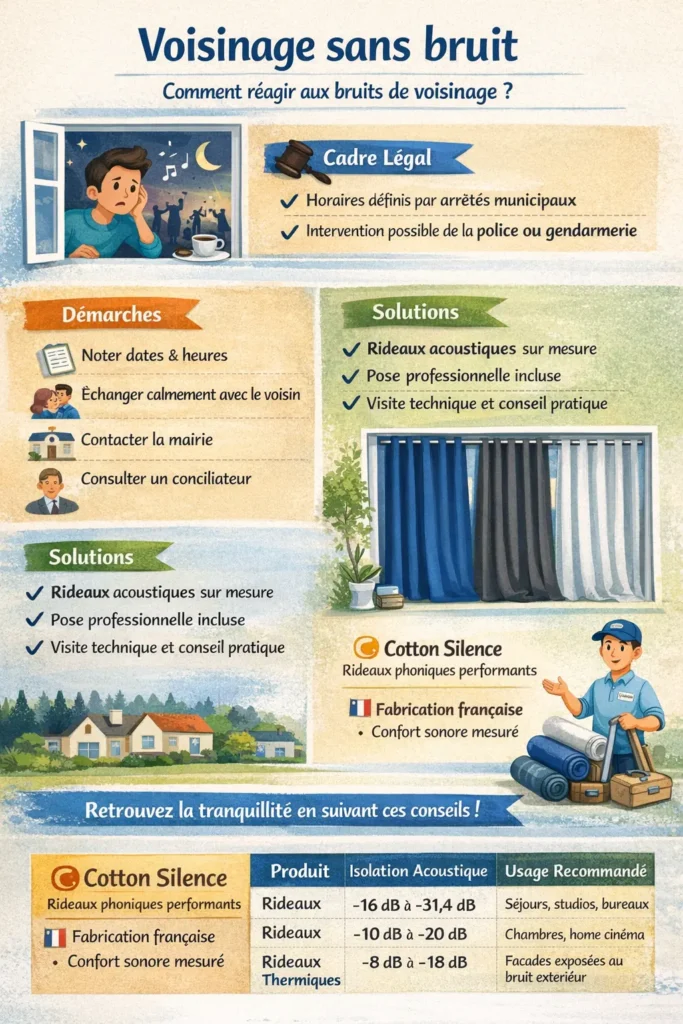
- Legal framework: Compliance with these hours is governed by municipal ordinances and enforced by the municipal police or the gendarmerie.
- Steps to take: Providing dated evidence and maintaining a friendly relationship with your neighbor often helps resolve the issue without legal action; otherwise, you can turn to the city hall or a mediator.
- Solutions: Custom acoustic curtains, professional installation, and a technical consultation significantly improve acoustic comfort.
The neighbor is throwing a party that spills over into the house next door late into the night, and the coffee cup shakes on the table. The sound of the lawnmower in the morning echoes through the apartment as you eat breakfast. DIY projects that go on all week long disrupt the peace of the neighborhood and affect the residents’ health.
Being abruptly woken up in the middle of the night raises questions about the legal framework and applicable hours. A desire to avoid conflict often leads people to find out which rules to follow and what steps to take. Do you know the rules regarding noise levels on weekdays?
The national and local legal framework governing permitted noise levels in France
National law does not specify a single time for making noise, and regulations depend on local ordinances. Case law often uses nighttime as a reference point for addressing nighttime noise disturbances. The competent authorities responsible for enforcing the rules are the municipal police, the gendarmerie, the mayor, and the prefect. Referring to municipal and prefectural ordinances will allow you to determine the specific hours applicable to your street.
The legal principle of noise disturbances at night and the time periods generally recognized
Noise disturbances at night refer to noise occurring at night that is likely to disturb the peace or harm public health. This definition is governed by criminal law and the Environmental Code, as well as the Civil Code with regard to abnormal neighborhood disturbances. Local authorities may issue citations for noise disturbances at night, and the municipal police or gendarmerie will intervene upon complaint. The Public Health Code regulates certain types of noise pollution.
Local regulations vary widely from one municipality to another, and ordinances often specify time restrictions for lawn mowing, DIY projects, and parties. You can find the applicable ordinance by visiting the town hall’s website or consulting the department’s collection of administrative acts. The common examples below provide a useful guide to local enforcement.
| Activity | Business days | Saturday | Sundays and holidays | Note |
|---|---|---|---|---|
| Lawn mowing | 8:30 a.m.–12:00 p.m. and 2:00 p.m.–7:30 p.m. | 9 a.m.–12 p.m. and 3 p.m.–7 p.m. | 10 a.m.–12 p.m. | Common variations by municipality |
| DIY (drill, saw) | 8:30 a.m.–12:00 p.m. and 2:00 p.m.–7:00 p.m. | 9 a.m.–12 p.m. | Prohibited or strictly restricted | Check the municipal ordinance |
| Festival and Music | Quiet hours: 10 p.m.–7 a.m. | Quiet hours: 10 p.m.–7 a.m. | Often restricted and subject to reporting requirements | Applicable noise level limits |
The following section suggests specific steps to take before calling the police, with the aim of prioritizing mediation. An amicable resolution is often enough to calm tensions in the neighborhood and avoid a lengthy legal process. The formal steps include reporting the issue to city hall, seeking mediation, and filing a complaint if necessary.
- Evidence collected (dates, times, recordings) to document the nuisance
- A polite initial approach to the neighbor to try to reach a resolution
- Written notifications to the town hall and the property manager, if applicable
- Seeking the assistance of a judicial mediator before going to court
- A sound level measurement as a last resort to support the complaint
Le guide pratique d’action en cas de nuisance et l’offre Cotton Silence pour améliorer le confort sonore
The first step is to document the disturbance in writing and through recordings in order to prepare an effective course of action. The recommended procedure begins with a friendly discussion, followed by the sending of a certified letter if the noise persists. Public services such as the municipal police, city hall, and the judicial mediator are the usual avenues of recourse before taking the matter to court.
Cotton Silence conçoit et fabrique en France des rideaux acoustiques multicouches performants et esthétiques pour tous espaces avec pose professionnelle incluse
Le lecteur intéressé par une solution pratique reçoit une proposition claire : Cotton Silence propose le rideau phonique sur mesure adapté au séjour chambre ou bureau. La gamme affiche des réductions mesurables du bruit selon le modèle et une pose professionnelle pour garantir la performance. Le service inclut une visite technique et des conseils pour une installation optimale.
| Product | Approximate sound insulation | Main advantage | Recommended use |
|---|---|---|---|
| Acoustic curtains | -16 dB to -31.4 dB | High absorbency and lightweight | Living rooms, studios, offices |
| Blackout curtains | -10 dB to -20 dB | Light blocking and sound reduction | Bedrooms, home theater |
| Thermal curtains | -8 dB to -18 dB | Isolation thermique et phonique | Facades exposed to outside noise |
Installation and maintenance of acoustic curtains to ensure long-lasting sound insulation
Success depends on careful installation at the wall-ceiling joints to minimize sound leakage. A preliminary technical inspection allows us to measure the noise level and tailor the product to the home. Maintenance is simple: regular light cleaning and checking the fasteners will keep the product performing at its best.
The final decision rests with your local city hall and the official record of administrative acts to determine which ordinance applies to your street. If the disturbance persists, you may consider initiating mediation or requesting a noise measurement. Sharing this useful information may help restore peace and quiet to your neighborhood.