You’ve felt it before, haven’t you? Walking into a public space where the walls, ceiling, and even the floor seem to absorb every sound, where the neighbor’s conversation or the bustling room never disturbs your peace… There’s a real difference. It’s almost invisible, but you can feel it: acoustic quality is, in a way, the hallmark of a harmonious space.
Nous le savons bien, et vous aussi sans doute : l’isolation phonique, c’est ce qui transforme une expérience collective ordinaire en un souvenir agréable et marquant. Et chez vous, dans votre restaurant, dans votre salle de spectacle, ou dans votre espace de travail partagé, vous en faites un enjeu quotidien ? On va se poser les bonnes questions ensemble : comment choisir la solution acoustique qui correspond à VOS besoins, à NOTRE réalité de terrain ? Grâce à nos astuces, vous trouverez facilement un rideau phonique sur mesure.
The Importance of Understanding Your Needs
Avant d’imaginer des solutions, nous devons comprendre, jusqu’au bout, ce dont votre lieu a vraiment besoin. L’acoustique, ce n’est pas seulement du technique : c’est votre image, votre ambiance, vos utilisateurs qu’il s’agit de chouchouter. Vous pourrez ensuite opter pour un rideau isolant phonique.
What are the acoustic characteristics of the different areas in your home?
We sometimes have trouble distinguishing airborne noise from impact noise, too—do you always manage to tell them apart? A client told me he realized too late that the sound of heels on the floor of his café was drowning out conversations… when we thought we just needed to treat the wall. Airborne noise is the sound of speech and music floating through the air. Impact noise, on the other hand, travels through the structure: heavy footsteps, falling objects, vibrations. We must therefore analyze each room, each situation: is the atmosphere the priority, tranquility, or performance? And those reverberations that tire the ear, those waves that bounce too much—do you use them to create momentum in the room, or do you prefer effective absorption for your customers?
One non-negotiable point: regulations. Public-access facilities must strictly comply with rigorous standards—not only regarding safety, but also acoustic performance, the quality of insulation materials, sound absorption capacity, and more. Have you considered this? Customers, for their part, are just as demanding. Acoustic excellence becomes a hallmark of the venue; it impacts foot traffic, customer loyalty, and reputation. We’re talking about your success here.
Here are a few questions to help guide you:
Comment choisir l’isolation phonique ? Pour bien isoler, tout part du besoin : bruit aérien, impact ou les deux ? On regarde le type de logement, la structure du mur, et on choisit l’isolant adapté : laine minérale, ouate de cellulose, fibre de bois, mousse ou liège expansé. Chaque matériau offre un effet acoustique différent, un confort et une efficacité variables. Le secret ? Miser sur la bonne épaisseur, la densité, la masse, et la bonne pose. Rien ne vaut une isolation phonique bien pensée.
Quels matériaux pour l’isolation phonique ? Les matériaux isolants phoniques sont nombreux, mais chacun a sa fonction. Laine de roche, fibre de bois, ouate, mousse acoustique, liège, panneaux en cellulose ou polyuréthane : tous limitent la transmission du bruit, avec une capacité d’absorption qui varie selon la densité, l’épaisseur et la surface. Les matériaux biosourcés sont souvent plus écologiques, mais les synthétiques offrent un meilleur rapport performance/prix dans certains cas. L’idée, c’est de les adapter à votre projet intérieur.
Meilleure isolation phonique au meilleur prix ? Si vous cherchez une isolation phonique efficace sans exploser le budget, misez sur des matériaux comme la laine de roche ou la ouate de cellulose. Bonne absorption, bon coefficient d’affaiblissement, épaisseur variable selon les besoins : on est sur une solution performante. Pour encore plus de confort, pensez aux panneaux multicouches ou aux systèmes masse-ressort. Ils permettent de réduire le bruit tout en gardant un coût raisonnable selon la surface à couvrir.
Isolation phonique pour quel type de logement ? Appartement ancien, maison moderne, combles aménagés ou studio en centre-ville : chaque logement impose ses choix. Pour une cloison légère, on opte pour un isolant dense comme la fibre de bois ou la laine de chanvre. Pour le plafond ou le sol, préférez des panneaux multicouches ou des dalles acoustiques. L’important, c’est d’adapter la matière, l’épaisseur et le système (ossature bois, doublage placo) à la structure existante et à vos nuisances.
Comment améliorer l’isolation phonique ?
Start by identifying the weak spots: shared walls, floors that echo, ceilings that are too thin. Next, you can install acoustic panels, add underlayment to the floor, or replace single-pane windows with double-pane ones. Mass plays a major role, so the denser the material, the better. Installation matters too: make sure there are no acoustic bridges, or else the whole system will fail. And don’t forget, good insulation material also provides thermal insulation. Total comfort comes from all of these factors combined.
Quels sont les avantages de l’isolation phonique ?
Une bonne isolation phonique transforme radicalement votre cadre de vie. Plus de bruit de voisinage, de claquements, de conversations qui traversent les cloisons. Vous gagnez en confort acoustique, en tranquillité et même en valeur immobilière. En plus, les bons isolants phoniques sont souvent thermiques : ils réduisent aussi votre facture énergétique. Moins de stress, plus de concentration, meilleure santé : c’est un investissement intelligent pour toute la maison, du sol au plafond.
Have you ever faced sound-related challenges at your facility?
On croise tous des nuisances sonores inattendues : restaurant plein à craquer, couverts qui s’entrechoquent, discussions enflammées, musique omniprésente… Ou alors, vous gérez une salle de spectacle, et vous savez combien une mauvaise isolation phonique peut tout gâcher ? Personnellement, dans un théâtre où nous avons travaillé, chaque détail comptait : le rideau, la porte, la fibre de verre posée derrière les plaques, jusqu’à la sous-couche du sol. La moindre vibration mal gérée, et l’émotion sur scène s’envole.
We battle this noise every day, because it takes a toll on our ability to relax, on our productivity and concentration, and even on our morale. A space designed to minimize noise pollution makes all the difference—who hasn’t breathed a sigh of relief in an open-plan office that’s suddenly quieter, or in a restaurant where conversation flows without having to raise your voice?
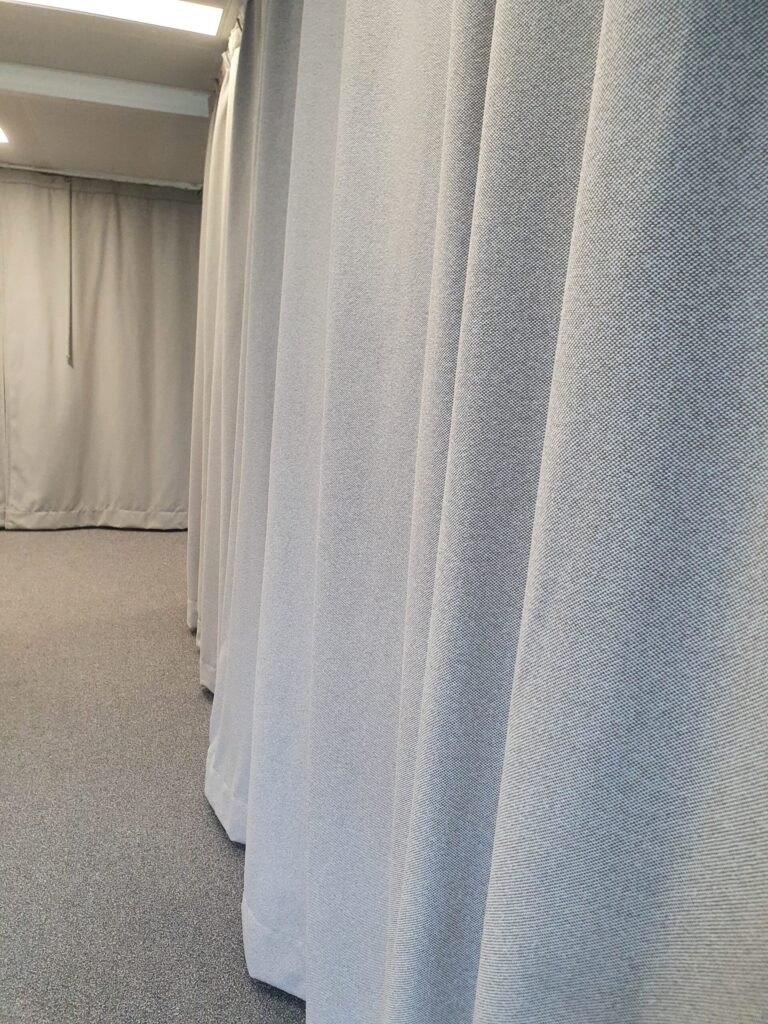
Le rideau acoustique sur mesure Cotton Silence Pro, bien plus qu’un simple isolant
Chez Cotton Silence Pro, on parle d’isolation phonique et acoustique comme d’un art à part entière. Chaque rideau acoustique sur mesure est pensé pour atténuer le bruit, absorber les ondes et isoler efficacement chaque pièce. Grâce à un assemblage de panneaux multicouches en fibre, laine de roche, ouate de cellulose et mousse minérale, ce rideau devient une vraie paroi isolante.
It plays a key role in reducing noise pollution, whether airborne or impact-related, while improving thermal insulation. In addition to providing exceptional acoustic comfort, the curtain offers real energy savings and peace of mind in your home. High-performance, dense, and available in natural or synthetic materials to suit your needs, it meets the most demanding technical standards.
Perfect for homes, studios, or public spaces, it’s an elegant, accessible, and durable solution—and, above all, one that’s tailored to every project.
Quels matériaux choisir pour une isolation thermique et phonique performante ?
Are you unsure about which acoustic insulation materials to choose? That’s normal—we’ve asked ourselves the same question a dozen times: mineral wool or foam? Cellulose wadding, panels, or bio-based insulation? Let’s figure it out together, step by step.
Which soundproofing materials should you choose?
Do you like things to be concrete? So do we. So, let’s take stock:
- Glass wool and rock wool: classic, proven, and easy to install in walls, ceilings, and floors. Choose the density and thickness that best suit your needs, and enjoy excellent value for money.
- Cellulose insulation: Are you into eco-friendly options? It’s also widely used in renovation projects, especially for attics. It can be installed by blowing it in or using panels, and its absorbency never ceases to amaze us.
- Expanded cork: Looking for a natural, sustainable, high-performance solution? We recommend it for spaces prone to impact noise. It’s more expensive, but the long-term benefits make it worth the investment.
- Do you prefer acoustic foam panels? Convenient for quick fixes or renovations, they can be installed anywhere and let you get creative with the design without compromising on effectiveness.
Performance of different products: what does the comparison reveal?
We all want to have a clearer picture before making a decision. Take a look at this comparison to get a better sense of the value for money offered by each option:
| Material | Airborne sound insulation | Impact sound insulation | Average price per square foot |
|---|---|---|---|
| Glass wool | High | Average | $10–$15 |
| Rock wool | High | Good | $15–$20 |
| Cellulose wadding | Average | Good | €20–€25 |
| Expanded cork | Good | High | €30–€35 |
Comment trouver l’isolation phonique qui vous correspond ?
Every building has its own priorities, and you often know them better than we do on the ground: performance, aesthetics, ease of installation, compliance with standards, and budget. But have you ever considered how much the right choice of insulation materials affects your customers’ satisfaction? Your staff’s comfort? The longevity of your investment?
Performance goal: How far do you want to go?
Do you run a theater that places a premium on sound quality? The experience of Sophie, an acoustician, illustrates just how much the choice of rock wool in a cultural space can make all the difference… She told me that simply opting for this material—recommended for its density and high absorption—had transformed a tiresome “sound cube” into a space that enhances both music and speech.
In a modern open-plan office or a doctor’s office, we’ll focus on other criteria to reduce background noise, create partitions, and limit sound transmission, all while ensuring optimal indoor comfort.
Cost or acoustic performance: which should take precedence?
Let’s be honest: we’ve all been tempted to go with the cheapest option, especially when dealing with large volumes. But the cost difference quickly disappears if the solution you choose ends up requiring major repairs a few years down the line. Durability, ease of installation, added property value… it all comes into play.
| Material | Installation cost | Service life | Estimated ROI |
|---|---|---|---|
| Glass wool | Bottom | 10–15 years old | 7/10 |
| Rock wool | Medium | 20 years | 8/10 |
| Cellulose wadding | High | 25 years | 9 out of 10 |
| Expanded cork | Very high | 25+ years | 9 out of 10 |
People often ask themselves: Is it worth saving a little money now if it means sacrificing efficiency, moisture resistance, or ease of maintenance? You’re the one who experiences the answer firsthand every day.
Tips that make a difference in your acoustic projects
Si vous voulez éviter les mauvaises surprises, rien ne remplace l’accompagnement d’une équipe formée à l’isolation thermique et phonique. Nous avons appris, parfois à nos dépens, qu’un bon diagnostic du bâtiment et une planification rigoureuse changent tout : oubliez les solutions “patch”, misez sur la cohérence du système d’isolation.
Do you know the key steps?
At our company, every project begins with a thorough assessment: we analyze the wall, the structure, moisture levels, and material density. Once we’ve agreed on a plan, we discuss the installation method (suspended ceiling, panels, rolls, blown-in insulation, etc.), feasibility, and the timeline. We also enjoy working hand in hand with local craftsmen or trusted partners, precisely to ensure high-quality workmanship and compliance with industry standards.
What mistakes should you avoid so as not to undo all your hard work?
You’ve probably heard it before: “We rushed the insulation job, and it didn’t make a difference…” And for good reason. Even with the best acoustic insulation, a rushed installation or choosing a material unsuited to the type of flooring, walls, or ceiling can undo all your hard work… Paying close attention to every connection, every joint, and every underlayment is crucial. We never hesitate to recommend double-checking during major stages—because it’s better to make one adjustment than to have to correct it ten times. Who hasn’t regretted neglecting the finish or the thickness?
If these issues resonate with you, if your project deserves the best in terms of acoustic and thermal comfort, and if you want us to work together to create a harmonious and effective environment for your audience, let’s talk. It’s often the right question that leads to the best decision, isn’t it?
Vos questions sur la meilleure isolation phonique
What is the best soundproofing?
The best sound insulation is one that combines several effective insulating materials, such as rock wool, wood fiber panels, or cellulose wadding. These materials have the ideal density for reducing airborne noise. For optimal results, proper installation is also key: double-lined walls, suspended ceilings, and floors with acoustic underlayment. The goal is clear: reduce noise, improve comfort, and optimize thermal insulation at the same time.
What is the most effective soundproofing material?
Among insulation materials, rock wool remains a benchmark for both acoustic and thermal performance. Its thickness and density allow it to absorb vibrations and reduce noise pollution. Cellulose wadding and wood fiber also offer excellent sound-dampening properties. It all depends on the substrate, the type of noise (airborne, impact), and the room to be insulated. The right choice always depends on your needs and budget.
What is the best insulation for soundproofing?
The most effective sound insulation is based on the mass-spring-mass principle. Heavy materials such as rock wool are combined with a flexible structure, with an air gap or an intermediate panel. This absorbs the sound wave and disperses it. In renovation projects, rolls of batting or high-density acoustic panels are simple and effective options. Good insulation improves comfort while reducing energy loss.
Quel est le meilleur isolant phonique ?
Le meilleur isolant phonique dépend de la situation. Pour les murs, on privilégie la laine de roche ou la fibre de bois. Pour le sol, le liège expansé ou une mousse dense. Le plafond peut accueillir un faux plafond avec panneaux minéraux. Ce qui compte : l’indice d’affaiblissement acoustique, la densité, l’épaisseur et l’ajustement aux contraintes du lieu. Un bon isolant phonique offre aussi un confort thermique durable et limite les pertes de chaleur.
How can I completely soundproof a room?
To achieve complete soundproofing, every surface must be treated: soundproof panels on the walls, underlayment on the floor, a suspended ceiling, and double-glazed acoustic windows. The key is the combination of insulation materials: mineral wool, acoustic foam, or cellulose wadding. The goal is to block noise, absorb sound waves, and limit transmission. You must also watch for sound bridges, seal gaps, and install each panel carefully.
Quelle est la différence entre l’isolation phonique et l’isolation acoustique ?
L’isolation phonique vise à empêcher le bruit de passer d’un espace à un autre (bruits de voisinage, circulation), tandis que l’isolation acoustique cherche à améliorer le son à l’intérieur d’une pièce (éviter l’écho, optimiser l’écoute). On utilise souvent les mêmes matériaux isolants : laine de roche, panneaux de bois, ouate, mais on les pose différemment selon l’effet recherché. Le bon système est celui qui s’adapte à la fonction de la pièce et à vos attentes.